
Air Duct Cleaning: Repair or Replace? How Hayes Barton Homeowners Decide
Cleaning a flex duct run with a collapsed inner liner doesn’t restore airflow. It removes surface debris from a tube that’s already choking off most of its designed capacity. That’s money spent on maintenance for a component that needs replacement. Here’s the short answer up front: in Hayes Barton, the repair-versus-replace call should come from a camera inspection of the ducts themselves, not from the age on the HVAC tag. Cleaning makes sense when the ductwork is structurally sound and the problem is contamination. Replacement makes sense when the ductwork has already failed. If you’d rather have someone look before you spend, call (833) 468-5692 and we’ll inspect first, quote second.
Why cleaning doesn’t always fix the problem
Most homeowners in Hayes Barton come to this question from the same place. Allergies won’t quit, the house hasn’t felt right since a renovation, or a new HVAC system went in and the airflow still seems weak. The assumption is that the ducts are dirty. Often they are. But dirt is only one of the ways a duct system fails.
A duct system has two jobs: carry conditioned air and keep it inside the duct. Cleaning addresses the first job. It removes the accumulated dust, debris, and biological growth that’s been pulled through the system. What cleaning can’t do is reattach a liner that’s peeled away from the duct board, reseal a joint that’s separated in the attic, or push a collapsed flex run back open. If any of those are present, you’re paying to clean the inside of a duct that’s still leaking or still pinched.
This is the threshold that matters. Cleaning is the right answer when the ductwork is intact and the contamination is the problem. When the ductwork itself is the problem, cleaning produces a short-term improvement that fades in a season or two, because the leak and the restriction are still there.
The distinction matters more than age. A rigid sheet metal system installed decades ago and still sealed may out-perform a brand-new flex install that was run carelessly. The calendar doesn’t know your ducts. An inspection does.
The structural failure modes that make cleaning pointless
In our experience, four failure modes account for most of the “cleaning didn’t help” calls we get in Hayes Barton. Each one is a sign that the duct needs repair or replacement before cleaning is worth doing.
- Collapsed flex duct. The inner liner of flex duct can sag or crush under its own weight, or get pinched where it’s routed through a tight attic run. Once it’s collapsed, the duct can carry a fraction of what it was designed for, no matter how clean the interior is.
- Delaminated duct board. Rigid duct board has a foil facing glued to a fiberglass core. When that facing lifts, fibers are exposed to the airstream and the duct loses its seal. Cleaning can’t reglue it, and sometimes the agitation of cleaning makes it worse.
- Disconnected joints in an unconditioned attic or crawlspace. A joint that’s pulled apart in the attic is leaking conditioned air into the outdoors and pulling unconditioned air back in. You clean the duct and it’s still disconnected.
- Crushed returns under slab. A return duct under a slab that has cracked or collapsed is a structural problem, not a cleaning problem. The only fix is replacement, and it’s a bigger job than most homeowners expect.
None of these show up in a visual walkthrough from the register. They show up when someone puts a camera into the duct and looks.
Camera inspection is the gate, not the afterthought
In Hayes Barton, the right sequence is inspection first, decision second, cleaning or repair third. Not the other way around. A camera inspection is the diagnostic gate. It tells you what you’re actually dealing with before a single brush goes in.
Here’s what we look for when we run a camera through a system:
- Duct condition. Is the liner intact? Is the duct board facing still bonded? Are there visible punctures, tears, or collapses?
- Joint integrity. Are the connections tight at the plenum, at the boots, and at every transition in the attic or crawlspace?
- Contamination type. Is the debris ordinary household dust and dander, or is there microbial growth, pest evidence, or construction debris from a recent remodel?
- Airflow path. Is the return sized correctly for the system? Is the supply side restricted anywhere?
The findings are what drive the recommendation. If the ducts are structurally sound and simply dirty, we recommend cleaning. If the camera shows failure in a specific run, we recommend repairing or replacing that run rather than cleaning the whole system and calling it done. That’s how you avoid spending money on cleaning ducts that can’t be fixed by cleaning.
Cleaning versus replacement: a realistic cost framework
Hayes Barton homeowners usually want three numbers: the cost to clean the system as-is, the cost to replace the failed sections, and the cost to replace the whole thing. Here’s the honest framework, with the caveat that every job gets a specific written estimate before work starts. The numbers below are typical ranges, and the written estimate sets the final price.
| Scope | What it covers | Typical range |
|---|---|---|
| Full-system cleaning | Source-removal cleaning of all supply and return runs, registers, and main trunk, with negative-air containment | $450 – $1,200 |
| Partial duct replacement | Replacing failed runs (a collapsed flex run, a delaminated duct board section, a disconnected joint in the attic) | $600 – $2,200 |
| Duct sealing | Mastic or aerosol sealing of minor leaks while the system stays in place | $500 – $1,800 |
| Full-system replacement | New ductwork throughout, often when the system was poorly installed or has failed in multiple places | $3,500 – $8,000 and up |
The numbers matter, but the sequence matters more. Cleaning a deteriorated system is the wrong purchase. Cleaning a sound system and then sealing it is often the smart one. Replacement is the right call when the failure is broad enough that patching one run just means you’ll be back for the next one.
When sealing is the right middle path
There’s a middle option between cleaning and replacement that a lot of Hayes Barton homeowners don’t hear about: cleaning plus sealing. It’s the right answer when the ducts are structurally sound, contamination is the main problem, but the system has minor leakage that isn’t worth a full replacement.
Sealing closes those gaps. Mastic sealing works well on accessible joints in an attic or crawlspace; aerosol sealing reaches the smaller leaks that a brush can’t. Combined with cleaning, it produces a measurably tighter system without tearing into ductwork that’s still in good shape.
What sealing can’t do is fix a collapse or a failed joint that’s already separated. Sealing is a bridge, not a rebuild. When we recommend it, it’s because the inspection says the structure is intact and the leakage is the remaining issue.
Age is a secondary factor, not the deciding one
It’s tempting to decide based on the age of the system. It’s also the wrong place to start. A rigid sheet metal system from decades ago, still sealed and properly supported, can out-perform a newer flex install that was run sloppily through a hot attic. The calendar doesn’t tell you what state your ducts are in. The inspection does.
That’s why we don’t lead with “if your ducts are older than X, replace them.” We lead with the camera. A Hayes Barton system from the 1990s that passes inspection may only need cleaning and a bit of sealing. A newer installation with a crushed return and a collapsed flex run may need partial replacement despite being far younger.
Age is useful as context. It tells us what to expect when we go in. It shouldn’t be the number the decision turns on.
When to call a pro
If you’ve had the ducts cleaned before and the airflow or allergy problem came back within a year, that’s a sign the cleaning addressed symptoms, not the cause. Same if you can see loose duct tape in the attic, a sagging flex run, or a joint that’s pulled free. Those are inspection problems, and they’re worth a look before you spend money on another cleaning.
Related services in Hayes Barton
If the inspection says the ducts are sound, air duct cleaning is the next step. If the system needs tightening rather than replacing, we handle sealing in the same visit. And if your dryers been venting into the same dusty air for years, dryer vent cleaning is a safety service worth having on the same call. When the whole HVAC system is due, HVAC cleaning covers the equipment side.
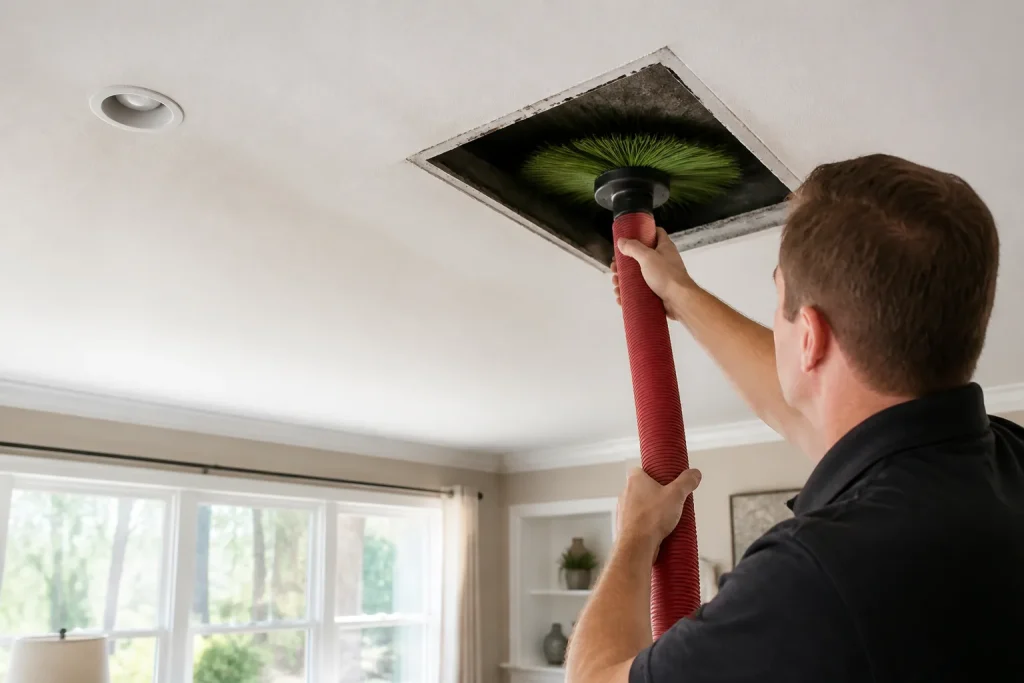
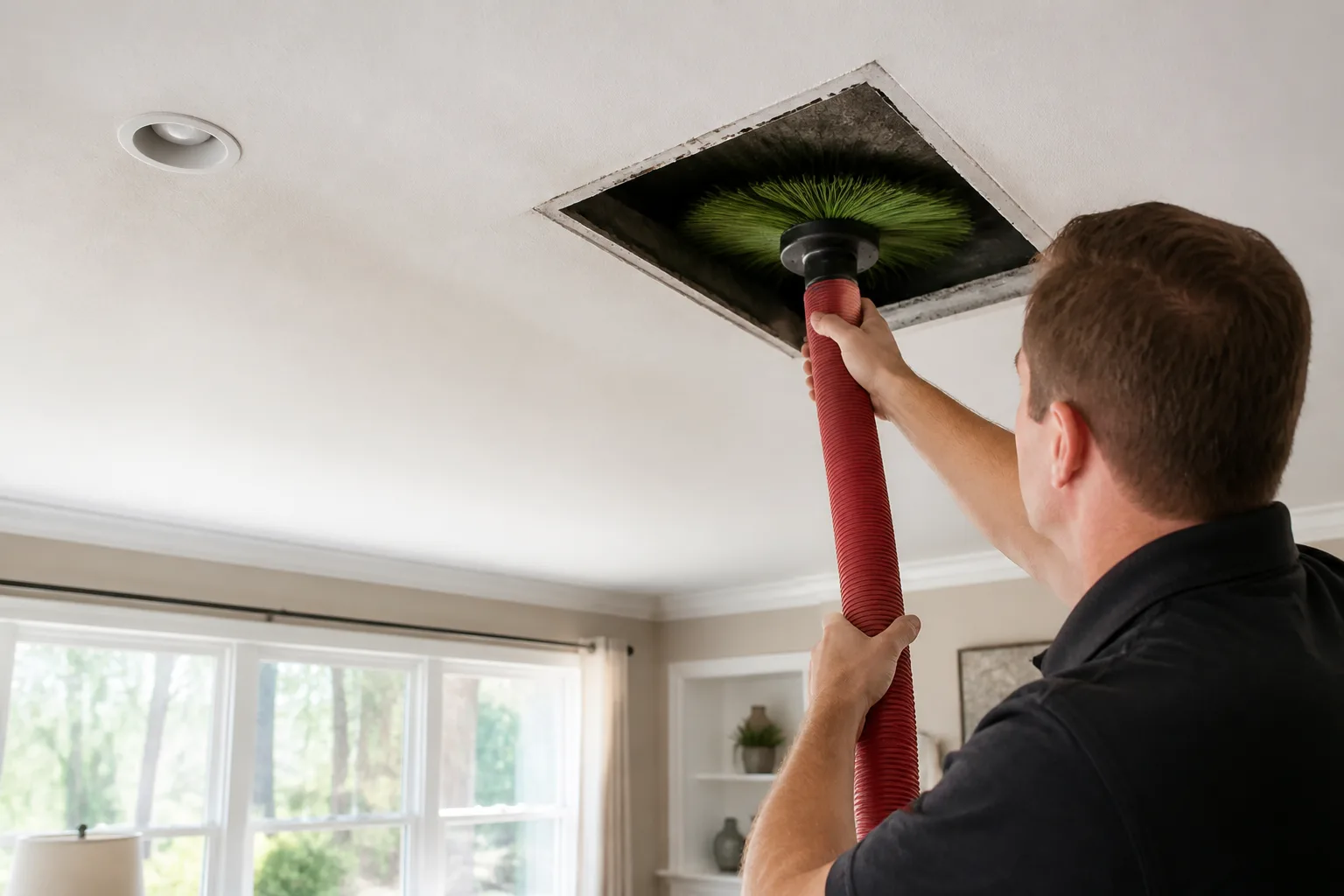
Our technicians use Rotobrush rotary brush systems and Nikro negative-air equipment so the cleaning is source-removal rather than a surface pass. We run Abatement Technologies filtration during service to keep dislodged particulates contained. And we work with Honeywell and Aprilaire filtration and humidification so the fix covers the whole system, not just the ducts. Our technicians have up to 10 years of experience.
The Bottom Line
In Hayes Barton, the cleaning-versus-replacement decision comes down to one thing: whether the ductwork is structurally sound. If it is, cleaning and possibly sealing produces lasting results. If it isn’t, cleaning is a stopgap. Camera inspection first, decision second, work third. That order is what saves homeowners from paying twice for the same problem.
We don’t quote a price over the phone; every job gets a written estimate, one flat price per system, agreed before any work begins. That’s how we avoid the bait-and-switch reputation the duct cleaning industry has earned. If you’re in Hayes Barton and want an honest read on whether to clean, repair, or replace, Air Duct Cleaning Hayes Barton offers free estimates. Call (833) 468-5692. We answer 24/7. Fast dispatch from 7am to 7pm, Sunday through Friday.
Frequently Asked Questions
A camera inspection is the only reliable way to know. If the ducts are structurally intact and the problem is contamination, cleaning is the answer. If the inspection finds a collapsed flex run, delaminated duct board, disconnected joints, or a crushed return, replacement or repair comes first. Age alone won’t tell you. Call (833) 468-5692 for a free estimate.
You can, but the improvement usually doesn’t last. Cleaning removes the debris from inside the duct, but it can’t reattach a liner, reseal a separated joint, or reopen a collapsed run. If the inspection finds structural failure, cleaning without repairing it is money spent on maintenance for a component that needs replacement. Call (833) 468-5692 to have us inspect before you commit.
Our inspection is part of the free estimate. We look at the ducts, review what we find, and give you a written price for whatever the system actually needs, whether that’s cleaning, partial replacement, sealing, or full replacement. No service-call fee, no diagnostic fee, no surprise number once a technician is on site. Call (833) 468-5692 to book one.
It depends on the home, not the calendar. Homes with pets, recent renovations, allergy sufferers, or smokers typically need cleaning more often than a well-maintained home with a good filtration system. A camera inspection tells you what your system actually needs. Call (833) 468-5692 for a free estimate and we’ll tell you honestly whether cleaning is worth doing now or later.
Written by the team at Air Duct Cleaning Hayes Barton.
Need Air Duct Cleaning Help?
Call Air Duct Cleaning Hayes Barton - the local pro we connect you with is licensed and insured, here with fast help in Hayes Barton.
(833) 468-5692